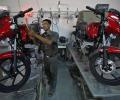
On the exports front, Bajaj is under pressure in Bangladesh and Africa. On the domestic front, it could ride improvement in rural demand and new launches but it also has to cope with competitive intensity and a high base. The management projects 7-8 per cent volume growth in domestic 2W in financial year 2025 (FY25) with moderation in H2FY25 due to a high base Y-o-Y.

HCLTech reported flat net income of Rs 4,235 crore in the second quarter of 2025-26 (Q2FY26) compared to last year, even as its revenue was up 10.7 per cent to Rs 31,492 crore helped by financial services and technology business verticals.

Equity markets this week would keenly track the upcoming GST Council meeting, macroeconomic data announcements and trading activity of foreign investors for further movement, analysts said. Moreover, developments related to tariff negotiations, global market trends and auto sales data would also drive investors' sentiment.

Japanese auto major Honda considers India a key market for its future growth alongside the US and Japan, according to Honda Cars India President and CEO Takashi Nakajima. The Tokyo-headquartered automaker, which operates in India through a wholly owned subsidiary, plans to drive in more SUVs in the country, as the segment continues to see robust sales across varied price points.
According to the figures released by the Society of Indian Automobile Manufacturers, total exports from the country stood at 23,39,333 units in last fiscal compared to 18,04,426 units in the year-ago period.

Festive buying spree unleashed by lower tax rates pushed gross GST collection to about Rs 1.96 lakh crore in October, registering a 4.6 per cent year-on-year growth -- the slowest rate so far this fiscal.

Domestic automobile retail sales declined 4 per cent year-on-year in July amid drop in demand for passenger vehicles and two-wheelers, dealers' body FADA said on Thursday. Overall registrations dropped to 19,64,213 units last month, as compared to 20,52,759 units in July 2024.

Electric passenger vehicle (PV) retail sales jumped more than twofold in September with Tata Motors (TaMo) leading the pack having over 6,000 registrations and a 40 per cent market share.

Among Sensex firms, Mahindra & Mahindra, Tata Motors, Trent, Eternal, Asian Paints and Infosys were the major gainers. However, Sun Pharma, ITC, Hindustan Unilever and Titan were among the laggards.

Manufacturers of passenger vehicles (PVs) in the first half of the calendar year (2025) reported a modest 0.5 per cent year-on-year increase in wholesale dispatches, while retail sales grew 2.5 per cent for the same period, reflecting a calibrated approach by automakers amid elevated dealership inventories and cautious consumer sentiment. According to the Society of Indian Automobile Manufacturers (Siam), dispatches rose marginally to 2.16 million units, up from 2.15 million units a year earlier.

State governments have requested the Centre for export incentives, lifting of import duty in the case of cotton for the textile sector and GST exemptions.

Exports of Made in India vehicles went up by a whopping 56 per cent during the last fiscal as cars, commercial vehicles and two-wheelers continued to charm overseas buyers.
The country's automobile exports went up by a whopping 65.3 per cent in 2002-03 as 'Made-in-India' vehicles, mainly cars and two-wheelers, continued to charm overseas buyers.

Among Sensex firms, Kotak Mahindra Bank, Larsen & Toubro, Mahindra & Mahindra, Maruti, Bharti Airtel and Tata Steel were the major gainers. However, Asian Paints and Bajaj Finance were the laggards.

The restructuring of tariffs by the US has led to a shift in the list of key product suppliers to the American market, with India emerging as one of the beneficiaries at the expense of China and Canada, an official said on Monday. As per an analysis, India's share in the USA's electronics exports has increased to 7.2 per cent to 3.5 per cent year-on-year in May, while China's share dipped to 11 per cent from 22 per cent during the same period.
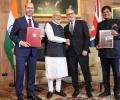
India and the UK on Thursday inked a landmark free trade agreement (FTA) that will cut tariffs on British whisky, cars and an array of items, besides boosting bilateral trade by around $34 billion annually.

Auto majors Maruti Suzuki, Tata Motors and Mahindra & Mahindra reported robust sales in September as reduced price tags owing to GST rationalisation led to record demand in the Navaratri period. The month also saw Tata Motors and Mahindra & Mahindra settling at number two and three positions, respectively in vehicle wholesales ahead of Hyundai Motor India.
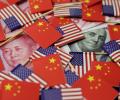
The trade war between the US and China is expected to benefit Indian exporters in increasing their shipments to the American market, sources said. They said the country was the fourth-largest gainer when the US imposed higher duties on Chinese goods during US President Donald Trump's first tenure.

Hyundai Motor India on Wednesday said the company is not facing any production issues due to the shortage of rare earth magnets. Replying to a query in the company's earnings conference call, Hyundai Motor India head of investor relations K S Hariharan noted that the company is maintaining an adequate inventory of the rare earth magnets.
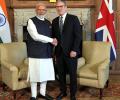
For UK automakers, market access to India will be limited by quantity caps and phased tariff cuts, especially on petrol, diesel and electric vehicles.
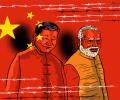
The bilateral trade between India and China has been growing at a healthy rate, but the trade gap remains sharply tilted in Beijing's favour. India has time and again flagged its concern over the ballooning trade deficit and the non-trade barriers faced by Indian goods in the Chinese market.

The automobile industry has sought government support in expediting approvals from the Chinese government for importing rare earth magnets used in various applications, including passenger cars. As per the industry sources, various domestic suppliers have already sought approval from the Chinese government through their local vendors in China.

US President Donald Trump's announcement of 25 per cent tariff on all goods coming from India starting August 1, plus an unspecified penalty, is expected to impact Apple's plans to expand iPhone manufacturing in India as well as export of other electronics to the US. The move comes at a time when Indian electronics production is reeling under pressure due to restrictions imposed by China on supply of several critical components, capital goods and even skilled technology professionals.

GST 2.0 may cushion consumers against US tariffs, but like the 2019 corporate tax cut, it risks being another tactical fix rather than a structural growth strategy, expects Debashis Basu.

From labelling India the 'Tariff King' to slapping sweeping import duties, US President Donald Trump has steadily hardened his trade stance on India. These announcements are being seen as a pressure tactic to get New Delhi to agree to demands made by the US in the proposed Bilateral Trade Agreement (BTA).
Overall, volume growth is likely to be in the range of 3-8 per cent for two-wheelers and 5-7 per cent for passenger vehicles owing to healthy demand from urban and rural areas and pending order books.

For the first time, the event will take place across three locations in Delhi: Bharat Mandapam at Pragati Maidan, Yashobhoomi Convention Centre at Dwarka, and India Expo Mart at Greater Noida.

The government plans to establish a fully indigenous manufacturing ecosystem with an annual production capacity of up to 6,000 tonnes. The scheme is expected to run for seven years, according to official documents.

'What India has done will surely embolden more countries to stand up to Trump.'
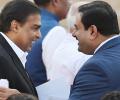
Who else will take on the might of Microsoft, Google, and Amazon if not the Adanis, Ambanis, Birlas, or Tatas?, asks R Jagannathan.
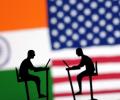
US President Donald Trump has announced a 25 per cent plus tariff on India from Aug 1. Trump, describing India as a "friend", said the US has done relatively "little business" with the country because of its high tariffs.
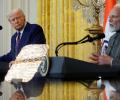
The deal fell through over unresolved disagreements over contentious issues, mainly on agriculture and automotive sector tariffs.
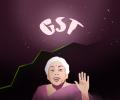
Lower rates effectively increase disposable income, strengthen purchasing capacity, and support broader consumption growth.

India and the UK will sign a free trade agreement on Thursday in London that will allow export of labour-intensive products such as leather, footwear and clothing at concessional rates, while making imports of whisky and cars from Britain cheaper. The pact also helps double trade between the two economies to $120 billion by 2030.

India will take all necessary steps to safeguard and promote national interest, Commerce and Industry Minister Piyush Goyal said on Thursday, a day after US President Donald Trump announced 25 per cent tariffs plus penalty on domestic exports to America from August 1.
India's decision to reserve its rights to impose retaliatory duties on the US over imposition of tariffs on auto parts is a procedural move under the WTO agreement on safeguards and it will not affect ongoing negotiations on the proposed trade pact between the two countries, an official said. India on Friday proposed imposing retaliatory duties under the WTO (World Trade Organisation) norms against the US over American tariffs on imports of the country's auto parts in the name of safeguard measures.
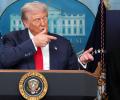
In trade negotiations, as in chess, sometimes you need to accept a temporary disadvantage to secure a better long-term position, points out Sonal Varma, chief economist (India and Asia ex-Japan) at Nomura.

Among Sensex firms, Tech Mahindra, HCL Tech, Eternal, Axis Bank, Maruti, Tata Steel, HDFC Bank and Asian Paints were the gainers. However, Adani Ports, Trent, Tata Motors, Hindustan Unilever and NTPC were among the laggards.
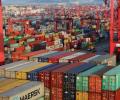
Exporters on Thursday sought a fund of Rs 750 crore for three years to tap USD 25 billion export potential in the US, aiming to seize potential opportunities that may arise as the US President-elect, Donald Trump, has threatened to impose high tariffs on Chinese goods. In its pre-Budget meeting with the finance ministry, Federation of Indian Export Organisations (FIEO) President Ashwani Kumar has also demanded extension of the five per cent Interest Equalisation Scheme (IES).
 © 2026 Rediff.com - Advertise with us - Disclaimer - Privacy Policy - Sitemap - Feedback - About us - Terms of use - Grievances